Owlbear and Wizard’s Staff Play Report Part Deux: A 1e High Level Glory Hole

The night was still young. Serpents had been slain. Treasures recovered. But now, it was time for an adventure of a different sort. We were about to descend into the GLORY HOLE DWARVEN MINE.

I expected puns, ponderous mapping, and possibly we would discover if Dwarven women had beards or not. (Spoiler: they do!)

The Owlbear and Wizard’s Staff Convention was in full swing. Competing with my evening slot on Friday was the famed Convention Curry Night, which had its own sign-up sheet. I remember thinking: what game would tempt a player away from the lure of vindaloo and lager?

Well… what’s spicier than a Glory Hole?

I’d picked up the Judges Guild module maybe a year earlier, cheap on eBay. If I’m honest, the title alone sold it. A quick skim revealed there were bits I’d never use. Without spoiling too much, there’s a section where PCs can find garbage cans, baseball bats, and flashlights. Artifacts from a ‘modern’ past.

Still, the core dungeon looked strong. A sprawling mega-dungeon focused on faction play, with rival groups exploring the gemstone mines outside the City State of the Invincible Overlord. That alone made it worth a spin.

I loaded up my event onto the schedule, and soon after Matthew — the organiser of OBWS, lovely bloke all around — asked if he could put a disclaimer on the game listing:

“There is no X-rated content in this game.”

Of course! The idea only added to the absurdity of the module’s name.

Lewis Pulsipher reviewed the Glory Hole in 1982:

“This was a decent idea, for the most part, but inadequately produced.”

How you butchered my boy, Lewis.

Well, I was about to find out for myself. Five players had signed up.
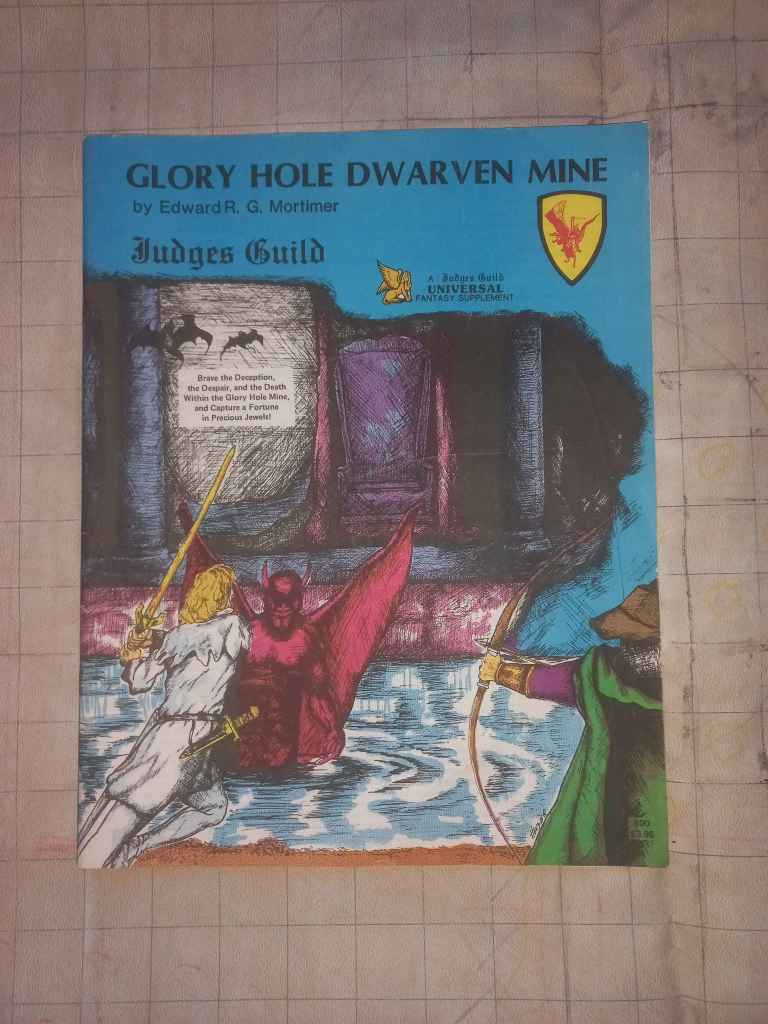
THE HOLE

Game Prep

Unlike The Setian Vault, which I wrote myself and have run in my campaign, this dungeon was totally alien to me. I’d selected it before even finishing a full read-through.

I’m confident at winging things, but I sat down properly in the weeks leading up to the con to give it a full comb-through.

And there were… issues.

  • It’s written for the Judges Guild Universal System, which is basically D&D with the numbers filed off. No big deal at first…
  • Until I noticed the monsters were D&D-adjacent — but not quite. Gargoyles in the module, for instance, didn’t require magic weapons to be hit. “Ettins” were renamed multi-headed ogres and had different stats entirely. There were plenty of unique monsters.
  • There are tons of factions, all with plans. But the NPC stats are in one section, and the encounter text in another. Not ideal for con play with all that potential parsing.
  • The place is huge. Would this even work as a one-shot?
  • It recommends a party with a combined 50–60 character levels. That probably presumed a large table of players with mid-level PCs. I didn’t have that.

But hey — I had sign-ups, and I’m not one to back down from a challenge.

So I said: fuck it. Generated some level 10 characters from osricrpg.com, and slid up to that Glory Hole to show it who was boss. To help the players out, I pre-selected the spells for the casters. I also made notes for segment casting times and durations for each spell. I wanted to minimise looking up rules as much as possible during the game.

I decided to use the monsters as written in the module. I skimmed the NPCs, started making some faction notes, but eventually said: to hell with this, I’ll improvise.

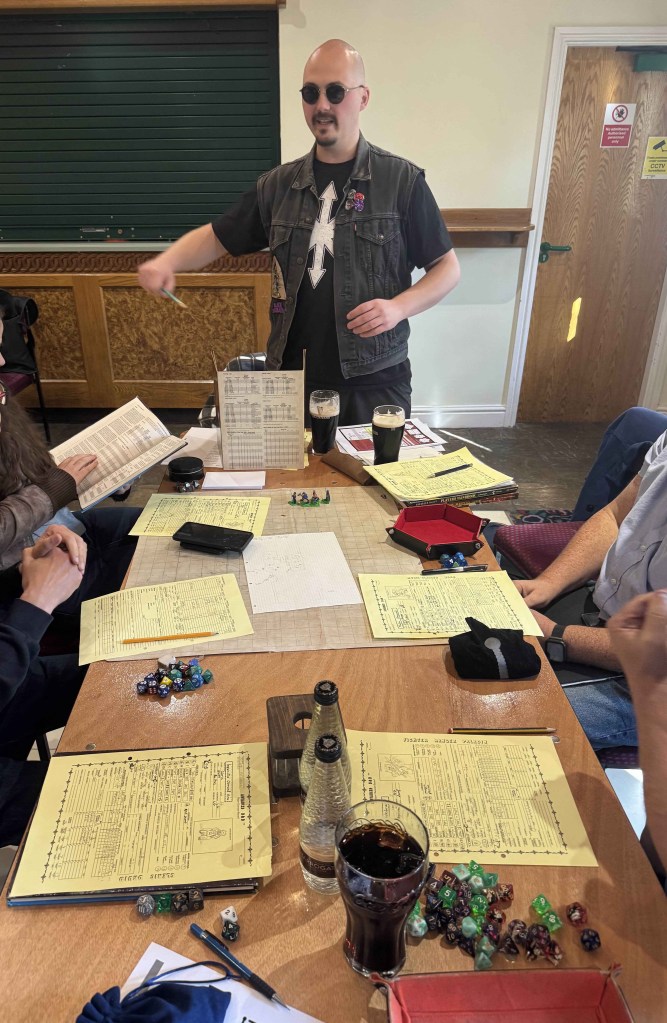
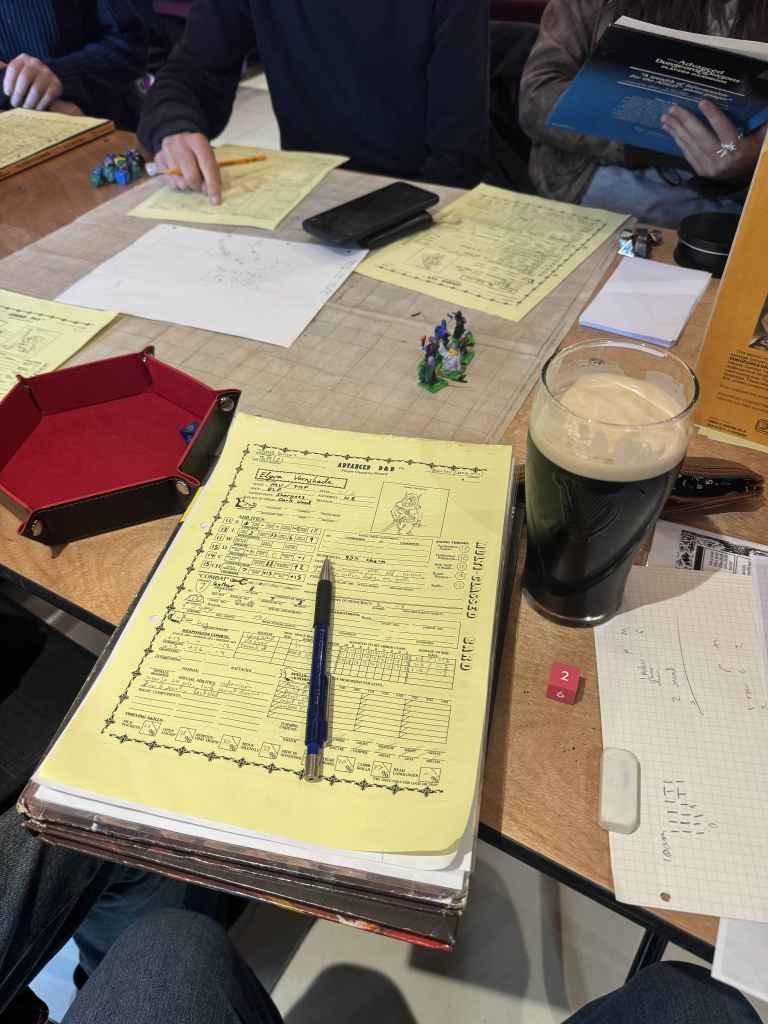
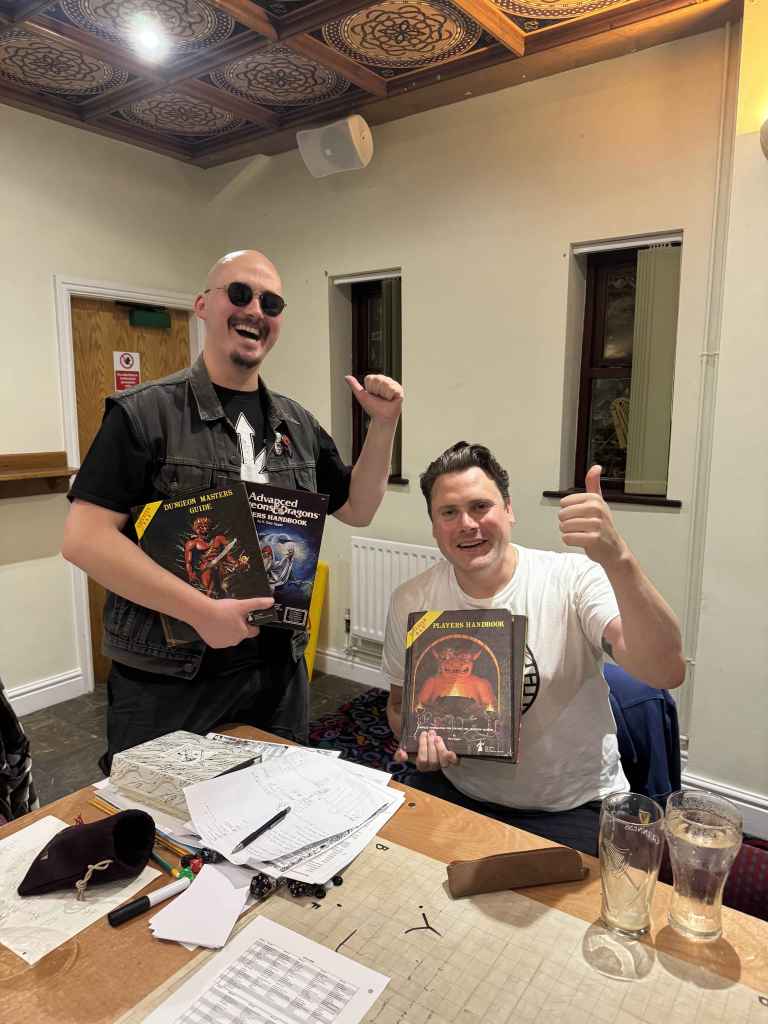
Fast forward to Saint Patrick’s Irish Club. Friday evening. The sun is setting. Dark forebodings. I sip my Guinness. Equally dark. My eyes are dark also, though not through choice. I’m wearing my sunglasses. Why? Because a few days ago I lost my prescription glasses. This is the only way I can see.

Sunnies in a darkened hall probably had everyone thinking I was that guy who wears sunglasses in the pub. Ha! Let them.

Behind my inky black lenses, I had enhanced powers of obscurement.
Witness my ultimate poker face.

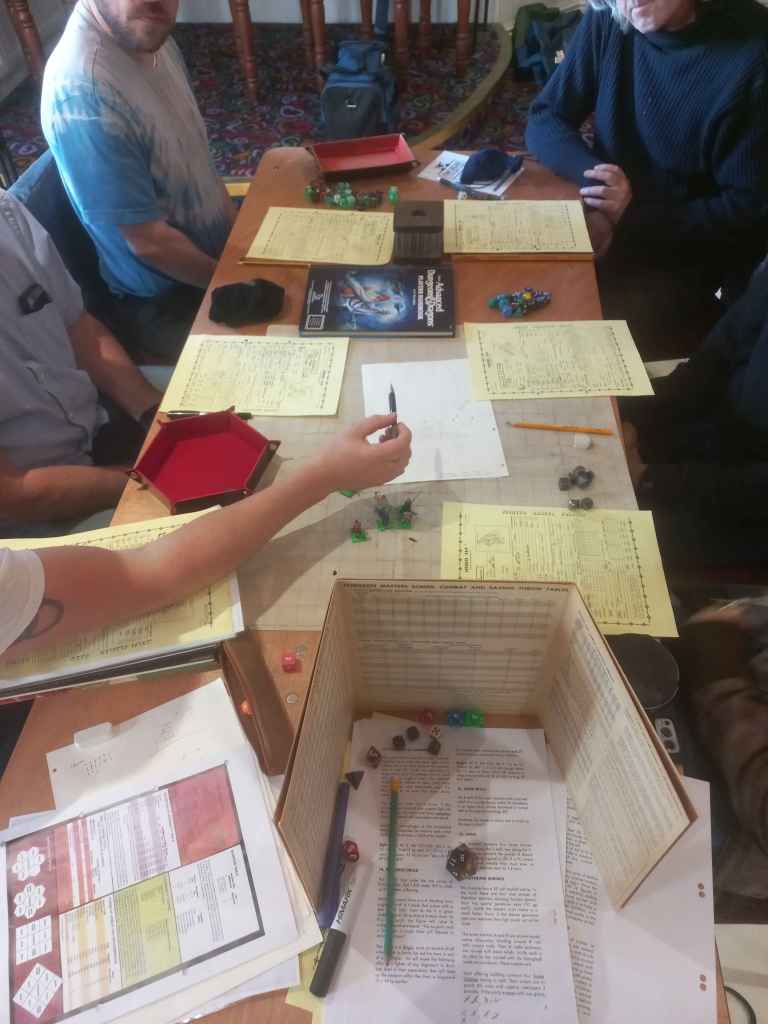
Then the players arrived at the table.

“Are you here for the Glory Hole?”

The Party Gathers
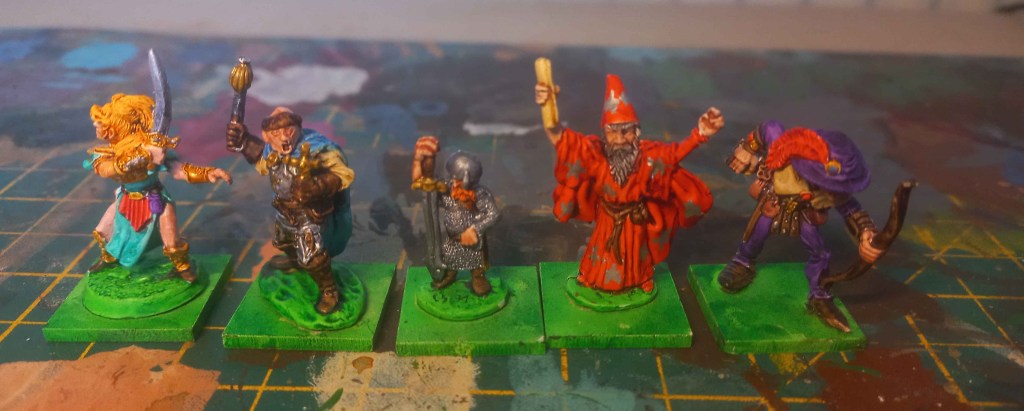
Our PCs
  • James KnightMeomesiene, Human Cleric (10), Lawful Good
    Items: Helm of Comprehending Languages, Potion of Invulnerability, +1 Small Shield
  • AndrewGodanova the Spiritual, Half-Orc Fighter (10), Chaotic Evil
    Items: +2 Two-Handed Sword, Potion of Growth, Scroll of Protection from Possession
  • DarrenOkar, Dwarven Fighter (7), Neutral
    Items: Javelins of Piercing, Potion of Gaseous Form
  • AndyKurlacon the Fearless, Human Thief (10), Chaotic Neutral
    Items: …Sweet Water (very useful)
  • Alin the Eldritch, Human Magic-User (10), Lawful Evil
    Items: Potion of Healing ×2, Potion of Copper Dragon Control, Scroll (Wall of Force), Wand of Enemy Detection

Note: No one picked the Illusionist I’d generated. Bummer. All the magic items were generated by the website. Some characters were luckier than others.

Second Note: One player’s name is missing — he arrived late and I forgot to note it on my record sheet. If you’re reading this, drop me a line!

The character sheets for this session weren’t printed on the fancy fake Goldenrod stock. I kept them cleaner: just the stats, saves, attack matrix, damage ranges, boxes for magic items, and all their prepared spells. Still, despite best efforts, they came out cluttered — as is tradition.

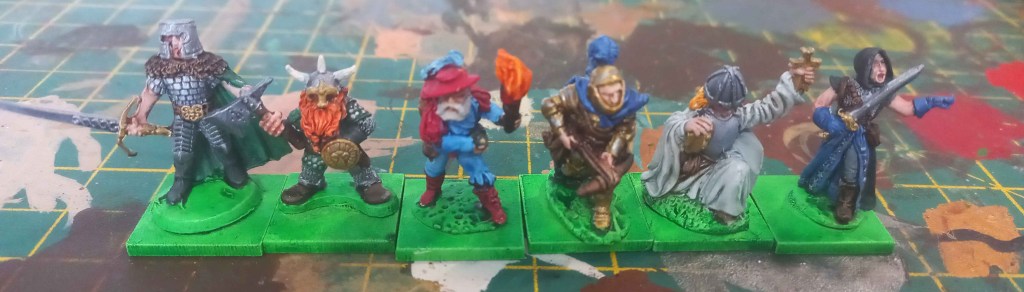
Players picked their characters as they arrived, first come, first served. They also chose from my pool of Ral Partha miniatures.

“I think I had this miniature back in the day!”

As a small bonus, I let the players roll 2d6 light footmen to accompany them.

I then asked the party to select a leader. Andy — with his tenacious thief — took the mantle.

I grew solemn.

“Now, I need at least one of you to step up to be the mapper. It won’t be an easy job.”

No kidding. Mapping this mine would not be a cakewalk.
(SPOILERS BELOW!)
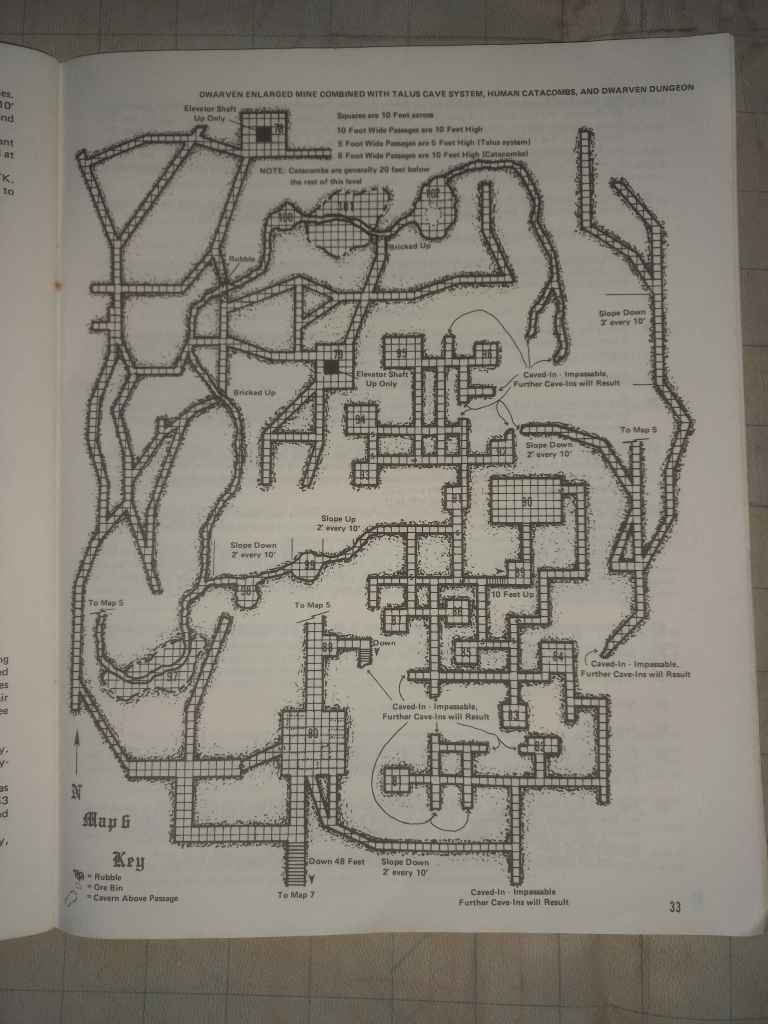
With gusto, Andrew stood and declared he was the man for the job. A brave soul. He had no idea what awaited him.

One last piece of upkeep:
The number of magic javelins needed to be rolled.
The MU needed to choose what type of Elemental he’d try to summon. Earth was the obvious choice.

We had a date with a Glory Hole.

The Goblinoid Massacre

The party strode into the place like Don Juan. And why wouldn’t they, for God’s sake? Look at them — levels dripping off every limb.

After some tunnels, they entered a large hall filled with empty mining crates. Up ahead, they spotted another adventuring party led by an Amazonian warrioress. The party had rolled surprise on her and so hooded their lantern. They watched. They listened. The female leader spoke — something about following a map.

The players decided to shadow them from a distance.

That continued for a bit… until a random encounter occurred (there are so many random encounters on this level — I guess that’s to simulate the crowds of parties and monsters descending into the mines).

I rolled: goblins.

Time to see what the party could do.

In a single one-minute round, the dwarf and the half-orc annihilated all twelve.
Those poor 1d6+2 HD gobbos never stood a chance. Their bodies lay brutalised across the battlemat.

A short while later — another goblin encounter.
You guessed it: more carnage. This time nine goblins. Gone. In under a minute.

“I roll five hits.”
“I roll six”
“Someone pass the man more d10s.”

These encounters caused the party to lose track of the Amazon’s trail. With no Rangers among them, they couldn’t trace her.

Four gremlins jumped out next — and died almost immediately.

The party was descending deeper. They now carried sacks of pilfered silver pieces. Alin the Eldritch hopped into a mine cart and rode down into level two.

Mutiny!

A quick jaunt through this level, it must be said.

As soon as they entered the area, they came upon an elevator shaft.

“Well, we want to go deep in this Glory Hole, don’t we?”


There was a resounding yes.

The lift worked by a set of man-powered wheels. The party demanded two of the light footmen man it and send them down. After a loyalty roll, they weren’t too happy about that. Alin the Eldritch stayed behind with them, essentially strong-arming them into the work.

The party descended in the lift and came upon a Cave Fiend — one of those new monsters. I quickly scanned the monster entry. It had good odds to surprise the party, but no luck on the dice. It sat there, squat and grey, eating two Dwarven corpses. We diced initiative. It took them two rounds to slay it.

Meanwhile, on the upper level, the two men-at-arms were whispering, readying to betray ‘ol Alin — throw him down the shaft! Alin overheard their plans and, with a quick magic missile or three, sent the men to their doom.

Unfortunately, this caused a random encounter, and bumbling into the room came a two-headed ogre who thought Alin looked like a most tasty morsel.

The wizard was snatched up, but a bit of luck with a reaction roll — the two heads started arguing over who got to take the first bite. The rest of the party below managed to race back up the shaft to save poor Alin before he became chow, killing the ogre in a couple of rounds.

Long-Legged Freaks

Torches lit. Their sacks in hand. The party returned down and explored some more. Graph paper was being thrown over to Andrew rapidly.

Through the caverns they trod. Into a huge chamber filled with more of those ore bins. There was a cave bear. That was one-shotted. The party didn’t even ask about skinning the thing. Whatever was going on!

But aha! Inside those bins awaited a nasty surprise: Black Widow Spiders. The Black Widows looked puny in the manual, so I rolled giant poisonous spiders from the MM instead. Aha! A challenge at last.

No.

The party was not surprised. Then some magical flying javelins took off. Magic missiles shot out. The fighter was smashing out three hits in round one. It was over fast. A hit or two from the spider venom was all saved.

Inside the bins was ore. There’s a mechanic for determining what kind. It was Fine Silver. The party took a bit, but it was bulky — and surely there would be better treasures ahead.

RIP Bong, Gono, Bond, Falty, Salty, Arco, and Tarco

The party carried on and soon found another lift. This one went all the way to the sixth level. They descended level by level.

On the way, they encountered their first group of dwarves. There were twenty of them, and the first six ranks fired bolts from crossbows at the party. Each firing, then dropping to a knee. That was nine shots in a round. Did the party take damage? Hardly. They charged in and slew seven of the poor bearded lads in two rounds.

The morale dice demanded the rest surrendered. After a brief back and forth, the party gave them some treasure and asked the survivors to join them deeper into the mine. On their travels, they had found a few veins of precious silver.

A few words were spoken for the fallen dwarves, who were named Bong, Gono, Bond, Falty, Salty, Arco, and Tarco.
Yes, the module names every dwarf NPC.
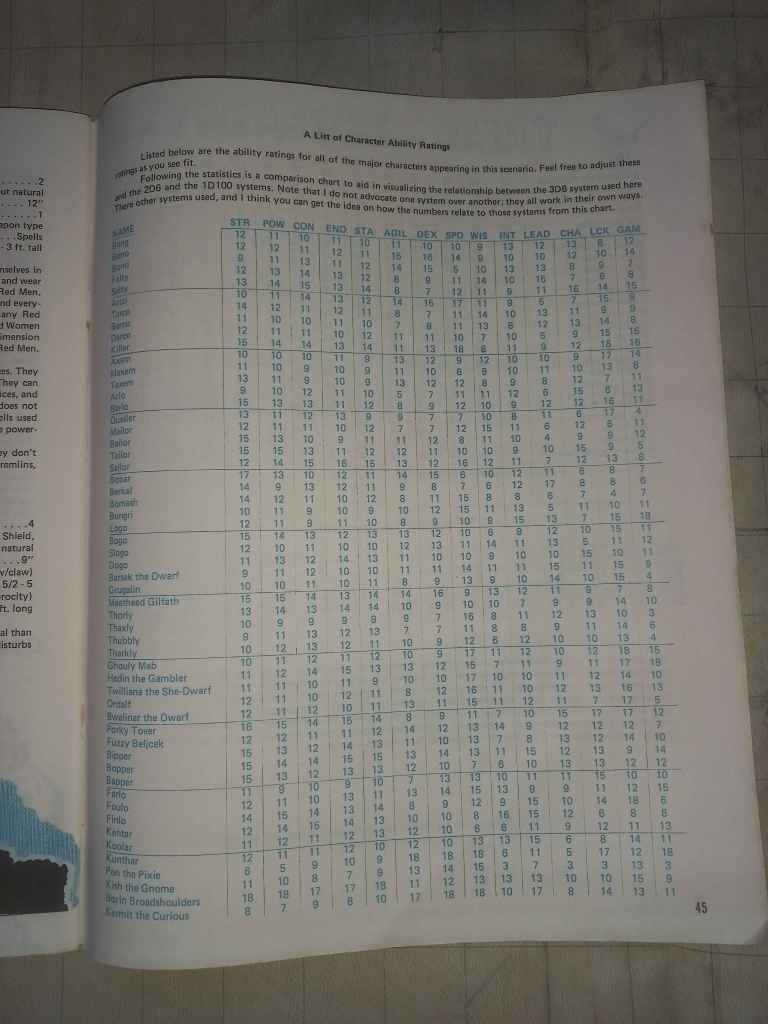
You wanted Dwarves, we’ll give you Dwarves!

Deeper Still

It was growing late in the day. The party had now descended all the way to the sixth level. How many times had I described forty-five degree passages and Y-shaped intersections? Undetermined.

The party had slain Cave Fiends, trolls, and a few green gargoyles.

During one particularly nasty combat against gargoyles, Alin the Eldritch had summoned a horde of troglodytes to his aid. Unfortunately, the stench from these beastmen had hampered the party’s own attacks.

But we were deeper now — in both pints of Guinness and shame. How many Glory Hole puns had we made? Never enough.

The party came upon a second Dwarf party, this time led by the exquisitely named Meathead Gilfath. This dwarf joined the expedition with gusto.

Soon the party were breaking through bricked-up corridors, sending their bearded miners ahead. These sounds almost always brought a random encounter, but these trifles were swatted away like pawns from a board.

“Let’s get through these bricked-up passages a little quicker, I have an idea. How much rubble have we excavated?”

It was time for the Elemental to be summoned.

Don’t Lose Control

The wizard Alin summoned his servant from the Plane of Elemental Earth and bound it to his will. With it, they smashed through several bricked-up chambers. The frequency of these sealed portals now led the party to believe they were on the track of a great treasure.

“Okay, you’ve moved twice with the Elemental out in front of the party. Roll a d20 ten times. Don’t roll a one.”

The players gathered their heads around the die. Alan’s player began rolling. He was nearly through them all… when that natural one appeared out of his fist. The table let out a roar.

The Elemental had turned against its master.

The 16 HD creature did more damage than anything else previously. Spiritual Hammers were thrown. Magic javelins loosed. HP was lost. The party were eventually victorious — but at some cost. Plenty of dwarves and men-at-arms were dead. Enough healing spells were used to fix up the party.

The Final Push

With that chaos behind them, the party followed a tunnel into a dark and natural cavern. There, in a high-roofed cave, they came upon the lair of the green gargoyles. The party found themselves pinioned in an archway as the creatures swooped down, ripping the dwarves to pieces.

The fighters had to step up and take the brunt. It was a punishing fight, and one particular gargoyle — bigger than the rest and wielding a magically glowing sword — caused serious pain.

In the end, the party caused the gargoyles great losses and drove them to flee up a large tube in the chamber’s ceiling, leaving behind a huge haul of gold coins — and the gargoyles’ eggs.

These were unceremoniously smashed. A shame, really. They could have made very unique pets in a campaign. Never mind. The victory was deserved.

The party packed up their coins. We had a brief calamity whilst getting back out of the dungeon. Time was running out. We counted out the moves. I rolled the encounter dice.

The party had spent twelve in-game hours in the deepest reaches of the GLORY HOLE, but they had emerged into the fresh Altanian air — richer, and alive!

The Happy Ending

As is tradition, I asked the victorious players to name their MVP. The legendary Andrew won without any contention, for he had studiously mapped the whole expedition and done a fine job.

He won himself a copy of Dray Prescot: 21 – A Fortune for Kregen. Not Appendix N, but a nice DAW yellow spined paperback regardless. Funnily enough, Andrew and Andy said they had just been discussing Kenneth Bulmer (the author). Andy has a great Moorcockian podcast where he focuses on SF and fantasy pulp fiction. I highly recommend it!
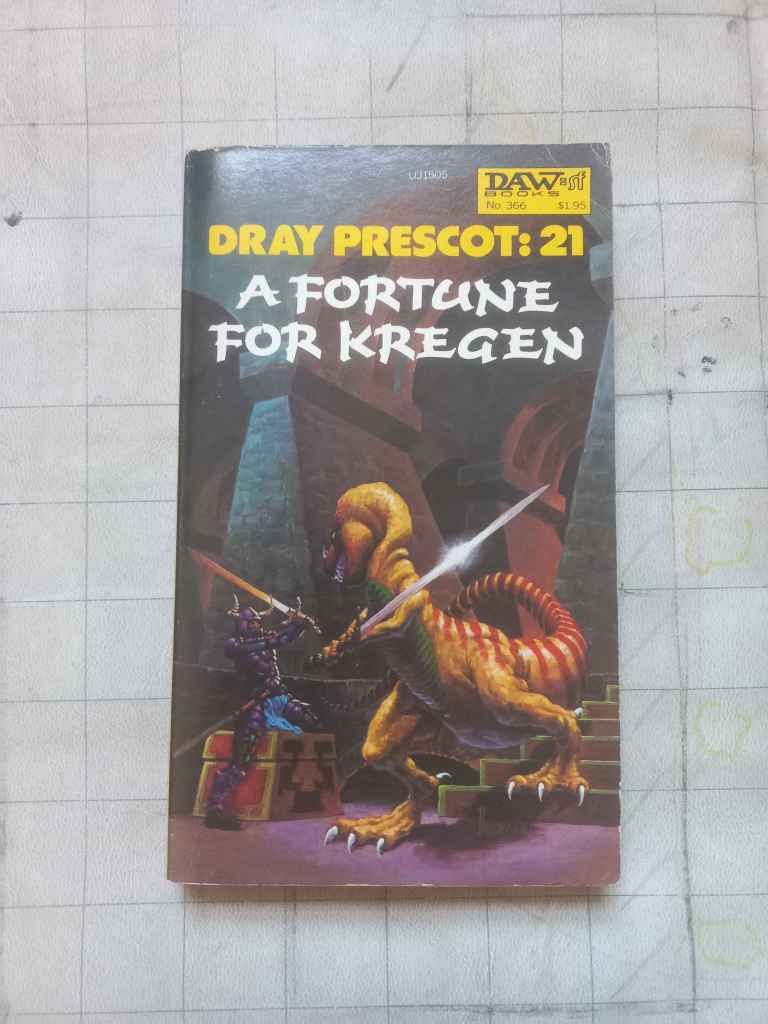
Now that cover would be an encounter!

Summary

The first day of the Con had come to an end. I was truly knackered, but elated. My attempt at running a fast-paced, high-level AD&D, sword & sorcery adventure was a success. We were laughing a lot. Sheets of graph paper were flying all over the place. D8’s were dropping all over the table as the players also helped me tally up HD with all these monsters we were encountering. It was a blast! 

Will I run the Glory Hole at a convention again? Probably not.

Do I recommend it as a module for your AD&D home game. With conversions and a bit of prepping, absolutely! 

I recommend any DM to run a seat-of-your-pants high level adventure with minimal prep, it may raise your blood pressure, but it will invariably lead to a good time, and plenty of jokes! 

Until next time, Fight on! 
Owlbear & Wizard’s Staff 2025 Play Report: Part One — The Setian Vault

The sun beat down. Wind raced along the river at my side. In my fist was a glass of black nectar, which I dutifully quaffed, my lips a’smacking in pleasure.

Then I saw it. At the far end of the beer garden, tucked beneath a curtain of dry, brown leaves, stood a lonely glass cabinet. I pushed through the foliage and found the figure within. He was robed in emerald, crowned in gold.

Saint Patrick. Banisher of Serpents.

I laughed aloud. Moments before, I’d finished running a four-hour game of AD&D where the players had slaughtered a nest of serpents and their snake-man kin. Had the old saint lent them his blessing? Or were their level 4 characters simply too powerful for the scenario?

I didn’t have time to ponder theology or blessings. My next session was about to begin, something God’s favoured would not smile upon. I was entering a Glory Hole. I also needed another Guinness.

I was at the Owlbear and Wizard’s Staff Convention, held in the picturesque town of Royal Leamington Spa. The sun had come out to smile on me, but there would be no basking in it. I was grognarding hard, ready to dive into TTRPGs, which require little light; only imaginary torches and enough illumination to read a d20 and a character sheet.

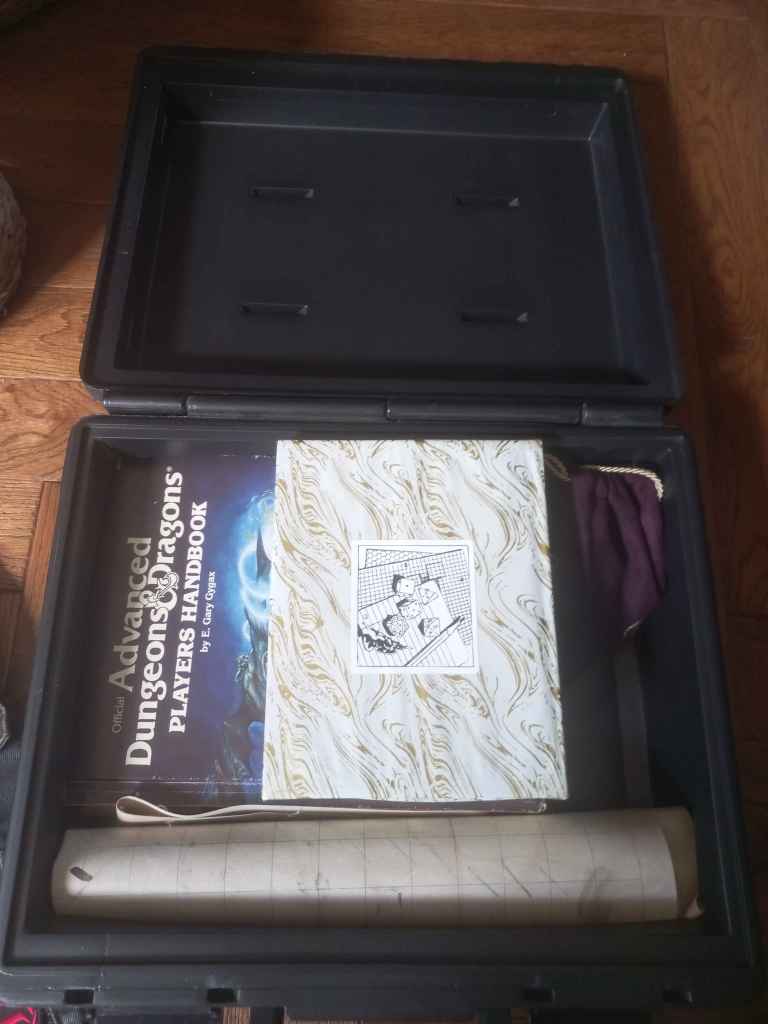
I’d arrived that morning, carrying a GW case stuffed with rulebooks and game notes. My belly was hungering for Sword & Sorcery action-adventure. The town made a pleasant impression, but such niceties had to be ignored. The location of St. Patrick’s Irish Club, host of the convention for several years, was charming—great Gaelic atmosphere, friendly bar staff, and dangerously cheap pints of Guinness. But this was no place for comfort. I was preparing for dungeon war.

The Carry Case of Doom

The crowds had gathered. RPG soldiers had come to crusade. A storm was a-brewing. This leaf-strewn town of Georgian beauty and green lawns was about to be dragged down into the gutter-level of Lankhmarian lowbrow imagination.

I’d enjoyed some chit-chat and met friends old and new, but in my mind I was preparing to inflict… the Setian Vault.

Session One: The Setian Vault

The Plan

The plan was simple. On Friday I would run two full sessions of AD&D, then drink beer.
Saturday, I’d lay back and enjoy a few games as a player—the kind I rarely get to try—and then drink more beer.
Sunday morning, I’d play in a single game before driving home to the South West, where a death metal gig awaited me. And, you guessed it… more beer.

Prep and Pre-Gens

Our PCs – Mostly Ral Partha

For Friday afternoon’s session, I plucked a low-level dungeon from my campaign milieu: The Setian Vault.

It’s important to bring pre-gens to a convention. Never waste precious table time on character creation if you can help it. AD&D is notoriously tricky for modern players to parse during chargen. They’re used to having all the pertinent information in one place. Reasonable fools.

So, in the weeks before Owlbear and Wizard’s Staff (OBWS hereafter), I generated eight character sheets at 5,000 XP each. I aimed for a spread of single-classed humans and multi-classed demi-humans. Levels ranged from 2 to 4. I made eight in total, giving the six players some choice and a couple of spares in case someone croaked—as can happen. That’s old-school gaming for you.

I’d also painted some old lead miniatures to match each PC, mostly Ral Partha I’d picked up from eBay job lots.

The Party

  • AlanThalric Greybeard, Half-Elf Cleric/Ranger (3/2)
  • DarrenBharak Blackbraid, Dwarven Fighter (3)
  • James KnightElyra Vornshade, Elf MU/Thief (2/3)
  • DavidVerrin Lusk, Human Thief (4)
  • HannahEmeric De Sablecroix, Human Paladin (3)
  • MikeOsmund Vire, Human Cleric (4)

All the players were pretty hardcore TTRPGers. A few were gents with stories of playing 1e back in the day. James is a regular in my campaign and plays tonnes of AD&D. One player had mistakenly signed up thinking it was a 5e game. I chuckled. This would be different.

The pull of AD&D at cons seems to break into three camps: nostalgia, genuine appreciation, and curiosity. I’ll lean into these aspects more next time I run an old-school game at a generalist con.

The Adventure

I informed the players that they’d heard the following rumours:

  • Children often play in a cave below Adder Hill. There is a dark statue within that local kids dare each other to approach. A few weeks ago, some kids reported a large gate had appeared in the wall, flanked by two golden wands.
  • Several cattle have been found mutilated around Adder Hill. Drained of blood.
  • A farmer swears he saw a host of “naked goblins” roaming the area.
The Ophidian Package

The golden wands intrigued them. The players selected characters. Casters were given ten minutes to pick spells. I generally advise experienced players to run them, especially Clerics, because they must pick spells from the entire list. 

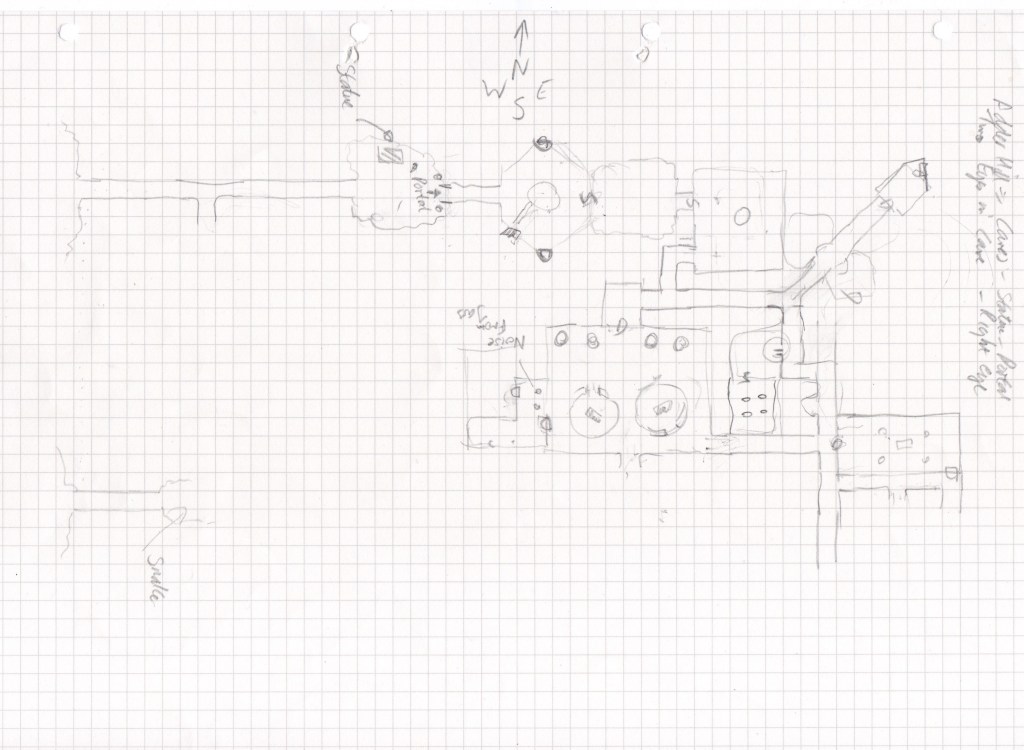
Hannah (Emeric the Paladin) was elected party leader. David took on mapping duties. Miniatures hit the table. A marching order was formed.

We were off to the races.

Exploration Begins

Adder Hill received its moniker due to its resemblance to a snake’s head. Two caves are set into its stony face like eyes.

The party entered the right “eye.” Elyra scouted ahead using her infravision. She soon detected a large heat signature accompanied by hissing. She wisely withdrew.

“I guess we know why it’s called Adder Hill,” quipped a player.

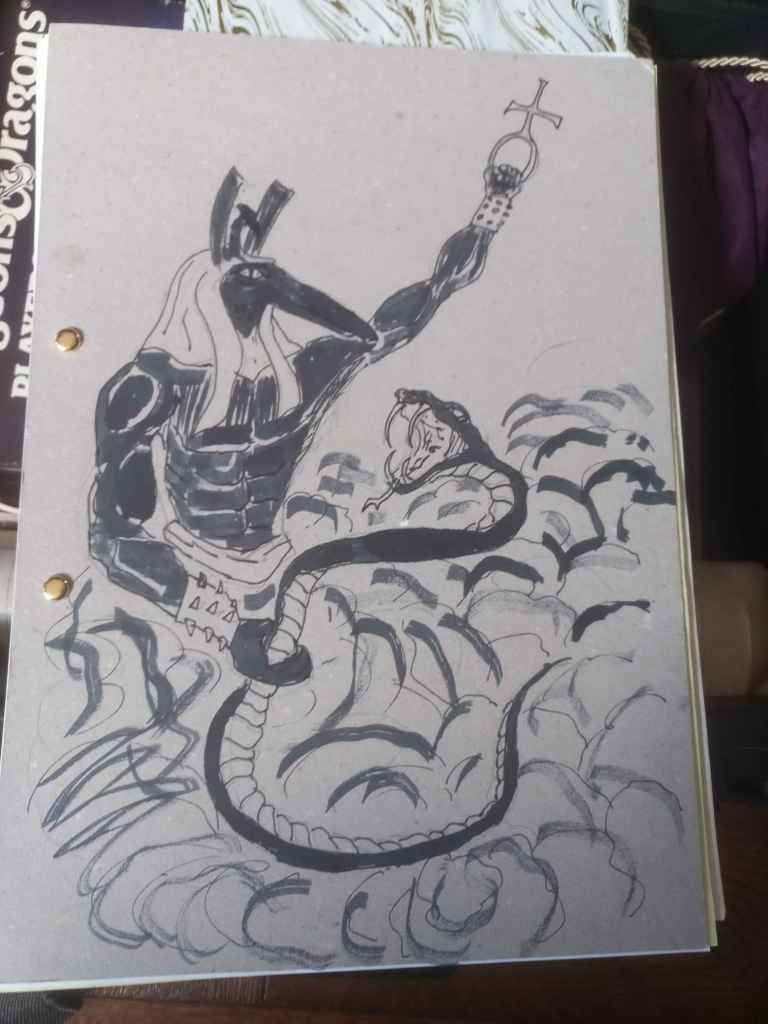
They tried the other “eye.” There, they discovered a beast-headed statue holding a serpent in one hand and an inverted ankh in the other: the symbol of eternal death. The paladin detected evil radiating from it. To the south, the promised gate loomed: carved in the shape of a snake’s open maw, flanked by crude sconces bearing golden serpent-shaped wands that projected cones of light.

As I was rolling for random encounters, a player voiced concern:

“I don’t know about walking through a portal that leads god knows where. We should send something in first.”

Ah, a Tomb of Horrors veteran. A tear of joy welled in my eye. But I corrected him—by “portal” I meant an arched gate, not a shimmering teleportation field. It was a hallway, echoing with the sound of water.

They pressed on, finding a gushing font beyond. Elyra spotted a secret door to the west. Inside was a rank chamber filled with small serpentine humanoids. Combat broke out. The paladin was blinded by venom. Still, he and the dwarf carved through their enemies. A bit of treasure was found. Another secret door was discovered.

Deep in the Dungeon

Snakes, Statues, & Strategy

This led to a hall with a rotating medusa bust at its centre. Much discussion ensued. Eyes were covered. Tactics formed.

They passed through into a large room with two conical reliquaries. Statues with gemstone eyes flanked the area.

Elyra listened at the reliquary door. The party formed up—except Alan, ever the wargamer, who recognised the potential of an enemy flanking manoeuvre, he pushed his Cleric/Ranger to guard the rear. Smart move. Two groups of serpent-folk burst from the reliquaries to encircle the party. They were soundly defeated.

The PCs pried out the gem eyes and smashed open one statue to retrieve a serpent-shaped wand that functioned like a magical torch. They headed east.

They came upon a room filled with strange urns. Issuing forth from these was the sound of a thrashing sea. Elyra had a listen at a door inside, and the crashing sounds of the waves grew louder and louder until she became utterly deaf. Luckily a spell was to hand to cure the affliction.

Mummy’s Eggs

They came upon a large hall. At its centre: a dais with glowing golden eggs. A diminutive mummy patrolled it’s surface like clockwork.

The party concocted a plan: four players would grab the eggs simultaneously. We diced. Verrin Lusk rolled poorly. The mummy bit him, and as he staggered back the mummy was dragged from the dais, and rapidly expanded to become full size. Battle erupted. The party fled.

As per old-school rules, fleeing characters can’t map. They got lost through the dark chambers, the wail of the mummy echoing after them. After wandering, they found another snake-maw portal, then a clerical office. Within the latter they smashed a statuette and found a scroll hidden inside.

Eventually, they reoriented themselves.

Deadly Detours

A giant spider appeared via random encounter but was quickly dispatched. (The ranger’s surprise negation is a real asset.)

They found the spider’s nest, torched it, and located a secret door leading to clay pots marked with wax seals. Some contained treasure. They left the skull-marked one alone. Very wise, very wise.

Finally, they entered a sloped hallway (angled at 45 degrees). Ten serpent-men were slain. Then they entered a candlelit chamber filled with maps and notes—here, they uncovered a dark plot (no spoilers).

In the next room: giant snakes. Silence was cast at the rear of the room, where a tapestry hid a door.

A Dark Mistress

Beyond the tapestry the serpents queen cast a darkness spell on the corridor. The paladin and the dwarf rushed through the magically darkened space, chasing their quarry. Behind the tapestry, they came face to face with a beautiful sorceress who immediately cast Charm Person on the paladin, bidding him to defend her.

Now we had a duel on our hands: the party leader versus the boisterous dwarf. Luckily for everyone involved, the dice were not in their favour. Many swings were whiffs.

Meanwhile, Osmund the Cleric stepped boldly through the darkness, carrying the magically silenced tapestry. He hurled it at the sorceress, interrupting her next spell and nearly knocking her flat. With the spell disrupted and her surprise lost, the remaining party members surged in and dispatched her, sending her back to her vile master in whatever abyss had spawned her.

The Player Map

Winners

All said and done, it was a successful expedition and a damn good time. The group gelled quickly, the session ran smooth, and the players engaged deeply with the old-school style. There were laughs, gasps, and dice hurled with intent.

As tradition, I asked the players to vote on who they thought was the MVP—the most entertaining or effective player at the table. On the count of three, they each pointed.

The winner was Hannah, who played Emeric the Paladin. Doubtless it was her tactical leadership and inspired (if slightly treacherous) roleplay in defending her newfound dark mistress that secured her victory.

She was awarded a copy of Kothar: Barbarian Swordsman by Gardner F. Fox. Pure Appendix N Sword & Sorcery. Just the kind of reward a paladin might keep hidden under their pillow.

Summary of Session One

The party navigated my traps, puzzles, and monsters with grit and cunning. I was two pints of Guinness down and feeling fantastic. In an hour’s time, I was going where no man should—the Glory Hole.

In my next post, I’ll continue this saga of one of the most fun TTRPG conventions in the UK. Let the blessings of Saint Patrick shine upon you, and never speak the names of abyssal demons aloud!

You can read another play report of mine for Grogmeet 2025 here.

Do you have any advice for running 1e games at Conventions? I’d love to hear your thoughts in the comments below!

Until the next post, Fight On!

[AD&D] A Mass Battle using Chainmail

I’ve been fascinated by the various methods Dungeon Masters use to tackle mass battles for some time, from hand waving them as a background event to the use of one roll resolutions like BECMI’s Warmachine. I’ve always been most interested by the use of miniature figures and wargaming rules to resolve these battles, having originally come into table top gaming by way of Warhammer Fantasy Battles.

So, several months ago, I made a conscious decision to try out all the various war gaming rules I’ve seen recommended for Advanced Dungeons & Dragons (my current rules set) until I find one that best suits my current campaign and tastes.

I have currently played through the introductory scenarios in the 1E Battlesystem supplement solo and found it has some interesting mechanics and integrates well with standard Ad&d play, but the attack resolution mechanic is just a bit too bloated for me – it has a massive table that to use you must first calculate an Attack Rating, and then do arithmetic each attack and search through the many rows to find the casualty number. Not too bad really, but after a couple of rounds of play it becomes tedious and saps the excitement out of the game.

After that I set out to try all the other methods; Chainmail, Swords & Spells, Delta’s Book of War, and regular Ad&d combat resolution scaled up.

This week one of my players was unable to make my regular game, and so with two fistfuls of painted minis I set up a battle for my two players, and we did a bit of play testing; player vs player with me judging.

This is a write up of that game, and a description of how I ran it.

The Armies

I decided to roll up two humanoid forces using the 1e Monster Manual. My reasoning was that if I want to use wargaming rules in my campaign there would be plenty of asymmetric armies cropping I play. The random generation method of the MM seemed a good way to test how Chainmail handles such unbalanced battles.

I opted to use Wood Elves vs Goblins and rolled up their numbers and weaponry as if it were a random encounter in the wilderness. Then I had to make conversions, matching up weapons, and lumping the forces into sets of 1:10 for their model ratios.

Partially the reason I chose these two monsters was because in Chainmail one is clearly superior to the other. I decided to make large changes to the way they present in Chainmail rules, and have them more in keeping with the statistics found in the Monster Manual. More on these changes later.

Goblins

  • 200 goblins with spears and slings – 20 Light Foot models with spear and sling
  • 50 wolf riding goblins armed with morning-star – 5 Light Horsemen with morning-star
  • 30 strong goblins (orc) with swords – 3 Heavy Foot

Elves

  • 40 wood elves with bows (and sword) – 4 Archers
  • 40 wood elves with spear – 4 Heavy Foot
  • 2 Fighter Lvl 1
  • 2 Fighter Lvl 2
  • 2 Fighter/MU Lvl 2/1

Rule Changes

My plan is to play this as if it were in an Ad&d campaign. The rules in Chainmail are not really fit for purpose as given. Most obviously, the Chainmail rules were written before 1e, and the abilities for these creatures were both vastly changed by 1978. Some of the strange differences found in Chainmail include Goblins hitting as Heavy Foot but defending as Light Foot, and all elves constantly being invisible and all carrying magic swords. These are rules designed to counter other fantastical beasts in the Fantasy Supplement, and they have no use for me.

These are the main rule changes I made:

  • Goblins are light foot.
  • Elves fight and move as they are armed; spearmen are Heavy foot, and bow wielders are Archers.
  • Classed NPCs fight and move as per the rules found in Anthony Huso’s updated cheat sheet for chainmail, which I believe uses material from Delta Book of War.
  • Elves can split move and fire.
  • Elves are invisible until they first attack, but not after that. This follows how they are written in the monster manual where they are able to blend in with grass and trees until they attack.
  • I am using simultaneous initiative for this game, which means the two players write down their orders and I adjudicate the moves as if they were concurrent.
  • I use the alternative rule for Morale, pg. 17 Chainmail; Instability Due to Excess Casualties.
  • Spells are identical to how they are found in Ad&d, and so only as effective as they might if all the men were individual tokens. These spells take effect in the Artillery phase.
  • Slings are the same as found in Ad&d RAW: 20″ range, ROF 1.
  • No measuring allowed by players.
  • I changed the turn order to this:

    1. Write Orders
    2. Simultaneous Movement (passing fire, split fire)
    3. Artillery (magic)
    4. Simultaneous ranged attacks
    5. Melee in weapon speed order.
    6. End.

The Set up

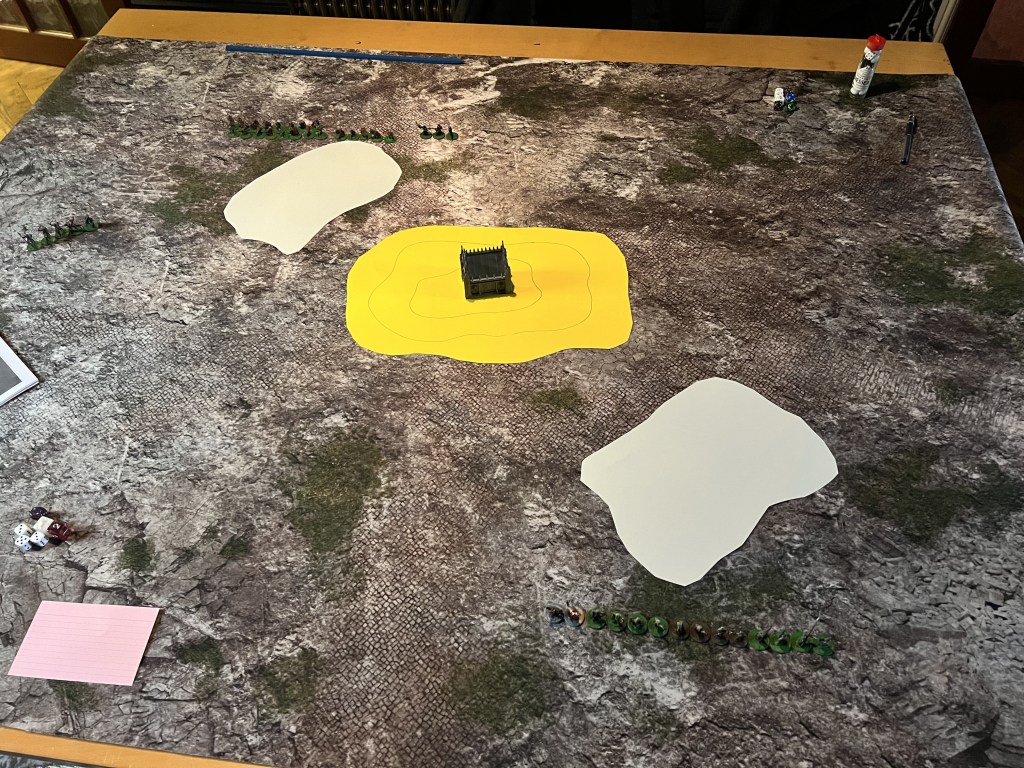
I created a scenario with a simple goal. The goblins need to spend two turns taking a ruin. The ruin is atop a hill and if they spend two concurrent turns on it unmolested, they descend into the dungeon below and win the scenario. The elves must stop this from happening, and either wipe them out, or make them flee, or hold them off until the end of the twelfth turn.

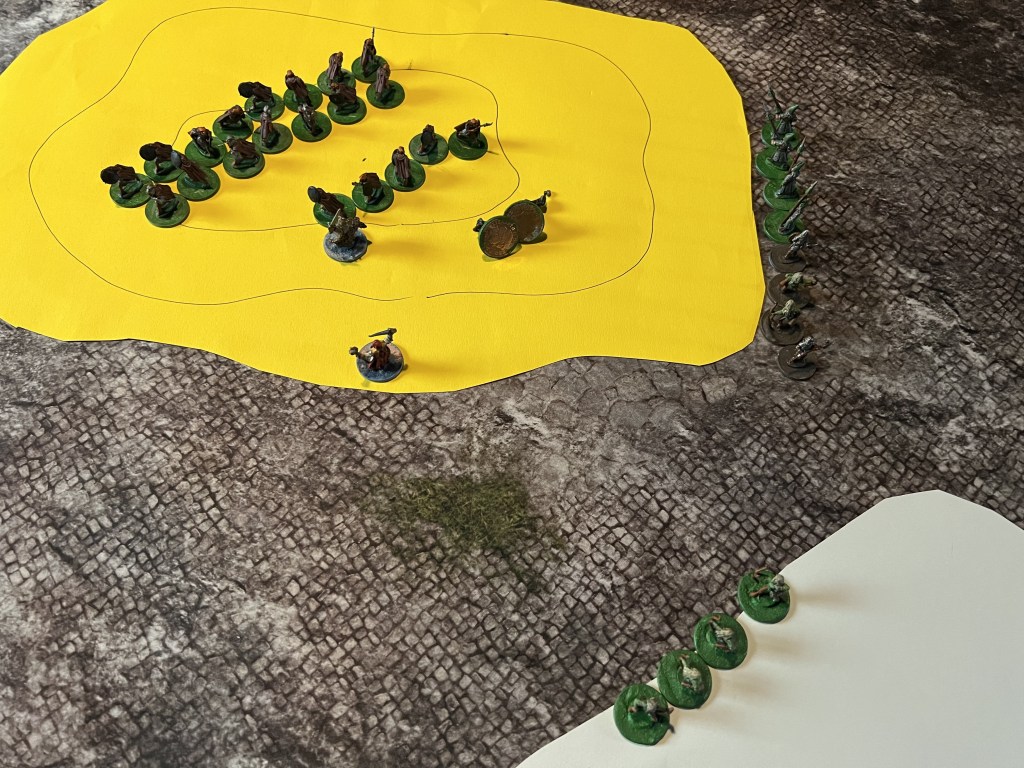
1. The yellow sheet is the hill, the black lines are the gradient of rising levels: moving uphill is at half movement, you cannot charge uphill, it blocks LOS.

2. The white sheets are woods; cavalry cannot pass, moves are at half pace, they block LOS.

Goblin Set up

The goblin player set up on the southern edge with this order of battle:

  1. the five wolf riders.
  2. fifteen goblins in a single unit, two ranks deep.
  3. the three strong goblins on the left, as a unit. Five goblins on the right in a single unit.
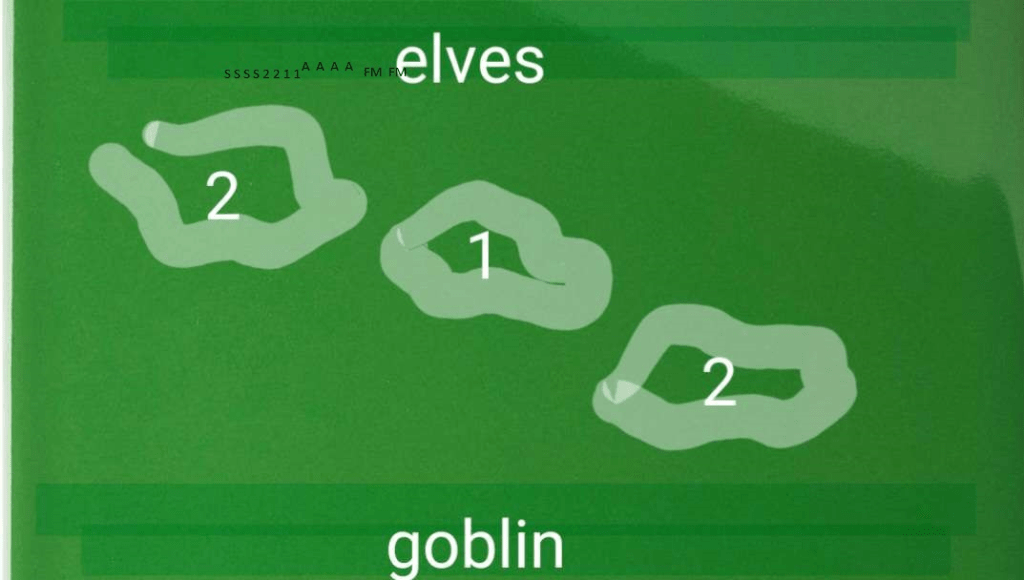
Elves Set up

The elf player set up on the northern border with this order of battle:

S. Spearmen
A. Archers
1. Fighter 1
2. Fighter 2
FM. Fighter/MU

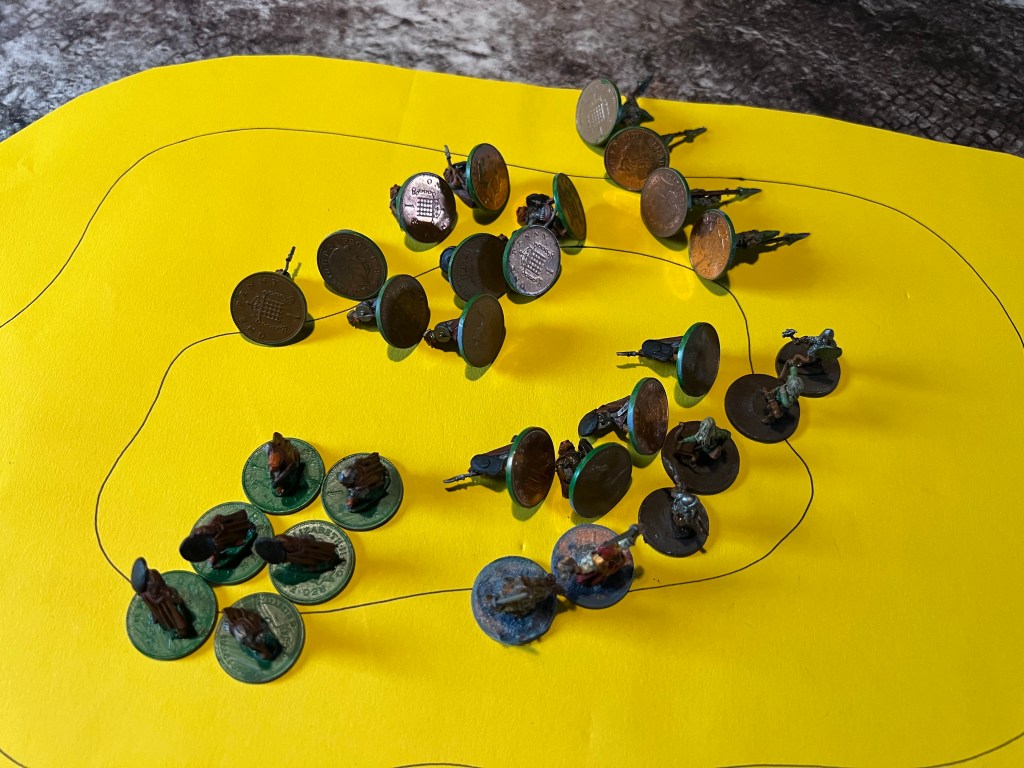
The set up was written in secret and handed to me, then I placed all the units on the table. The elves were invisible and the goblin player had no idea where they were. The photos below were taken afterwards, during the game I lined the elves table edge with die as tokens, and told them which ones represented what. I didn’t think this would be clear to follow in a blog post, so I reshot the battle afterwards.

Turn 1

Goblin ranks at the top, Elves at the bottom, ruin in the centre atop a hill.

Goblins orders: Wolves rush and circle the woods. Strong Goblins move towards hill. Remaining Goblins move into woods towards the hill.

Elves order: March into the woodland as a single unit, at the fastest pace possible.

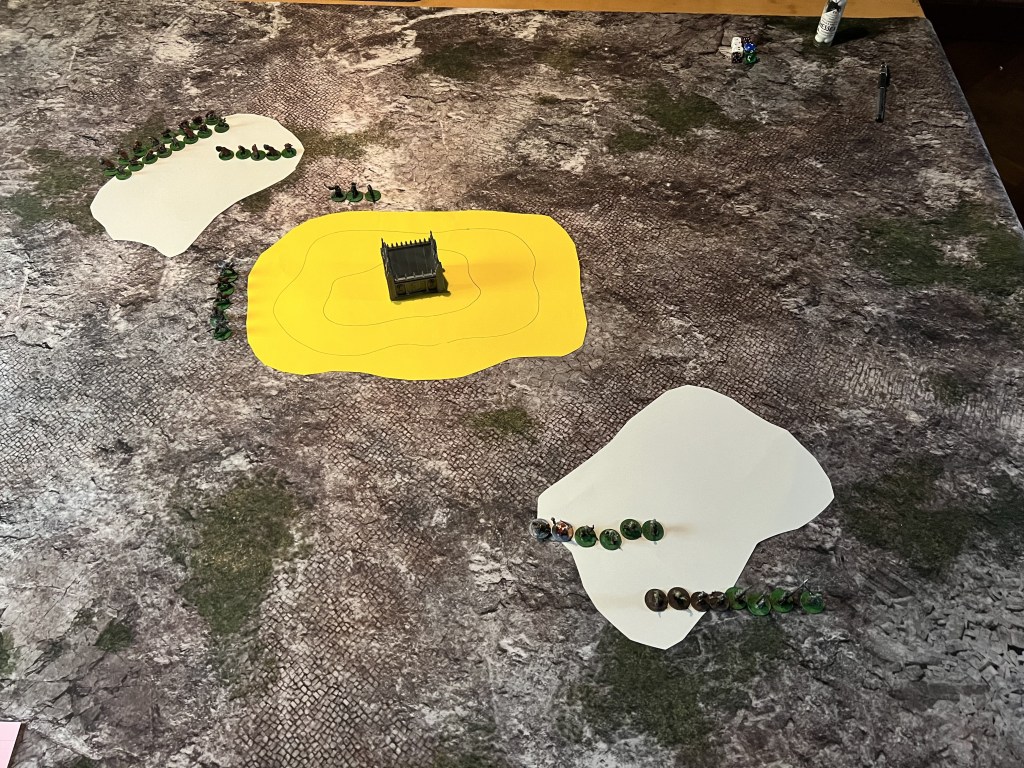
movement complete

The elves all moved in a single formation, but since the fighters move as Armoured foot they didn’t quite make it into the woods. The wolves have a very fast move, but used some of it pivoting.

Turn 2

Goblin Orders: Strong goblins and wolf riders take the hill. Other goblins get forward as fast as possible.

Elves Orders: I didn’t make it to the woods? Get inside those woods!

End of the round there was no firing with all the missile troops in wooded areas. The wolves pivot and get to the base of the hill, they know they will reach the top next turn, though they are totally unaware where the elves might be.

Down into the dungeons!

Turn 3

Goblin Orders: Wolves and strong goblins take the hill, the others follow up behind as quick as they can.

Elves orders: I want the archers on the edge of the wood looking at the hill. The Fighter/Magic users will go towards the hill. The spearmen and other fighters will move directly south and try to exit the woodland, next turn they will turn to face the hill.

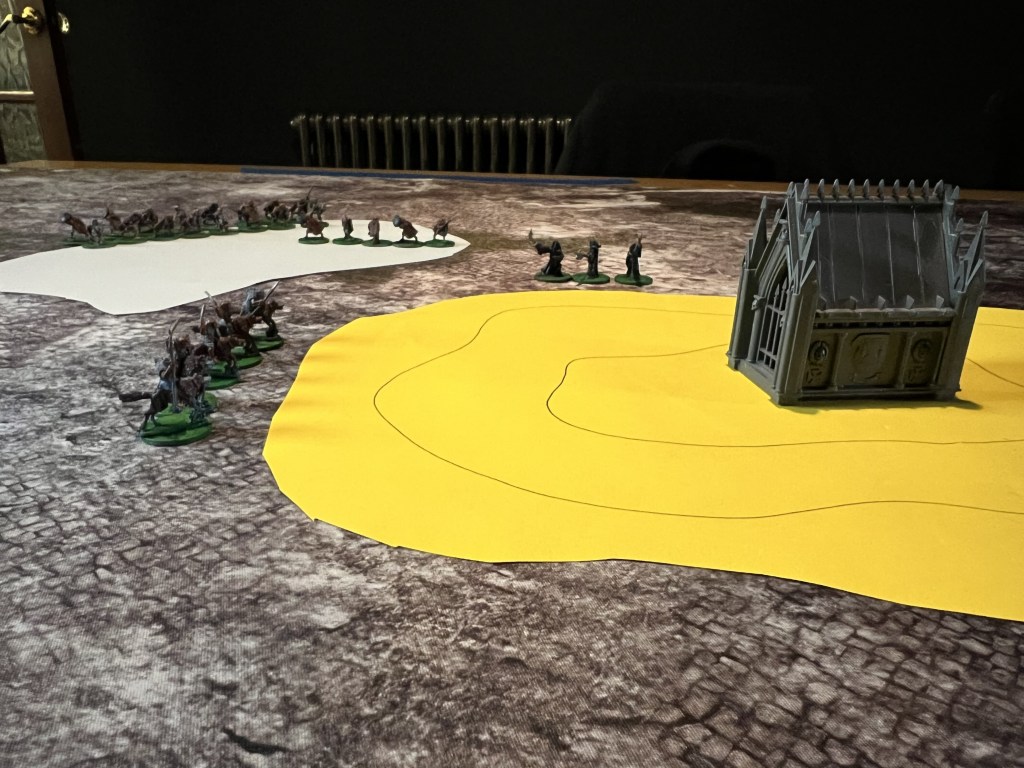
Dog meat

The wolves take the hill, their leader fast footed behind them. As they reach the top of the hill however, the invisible archers catch sight of them at the edge of the forest. The Elves have moved almost 50% of their allowance, so that means they can make one round of shots.

They kill thirty wolves and their goblin mounts in a hail of arrows. The elves are now visible in the tree line. The remaining wolf riders see their fallen comrades and must make a morale check. The player fails the roll and the remaining wolf riders break and are removed from the game.

Turn 4

Goblin orders: The strong goblins shout back for their men to reach the hill and ready their slings, they charge forward.

Elves Orders: The archers will remain and pepper the hill. The Fighter/MU will move forwards, invisible. The spearmen and other fighters will take the hill from the east, invisible.

orders from Mordor

The strong goblins have run too far forward, moving closely to the written orders, and the elves shoot into them. Luckily for them, only ten of them die, they later succeed their morale check. The other goblins are slowly climbing the hill, their 9″ movement significantly reduced. The elf spearmen, keeping pace with the armoured foot of the Fighters, still struggling their way through the woodland. The two F/MU go towards the hill, still invisible.

Turn 4

Goblin Orders: Those light foot will take the top of the hill, the smaller unit screening the large one, they will shoot their slings into those archers. Strong goblins stay where they are.

Elves Orders: Archers are shooting at the powerful goblins in front. One magic user will use Light, and target the commander of the heavy goblin’s eyes. The other magic user will move invisibly towards them. Those spearmen will get up the hill.

Bumrush

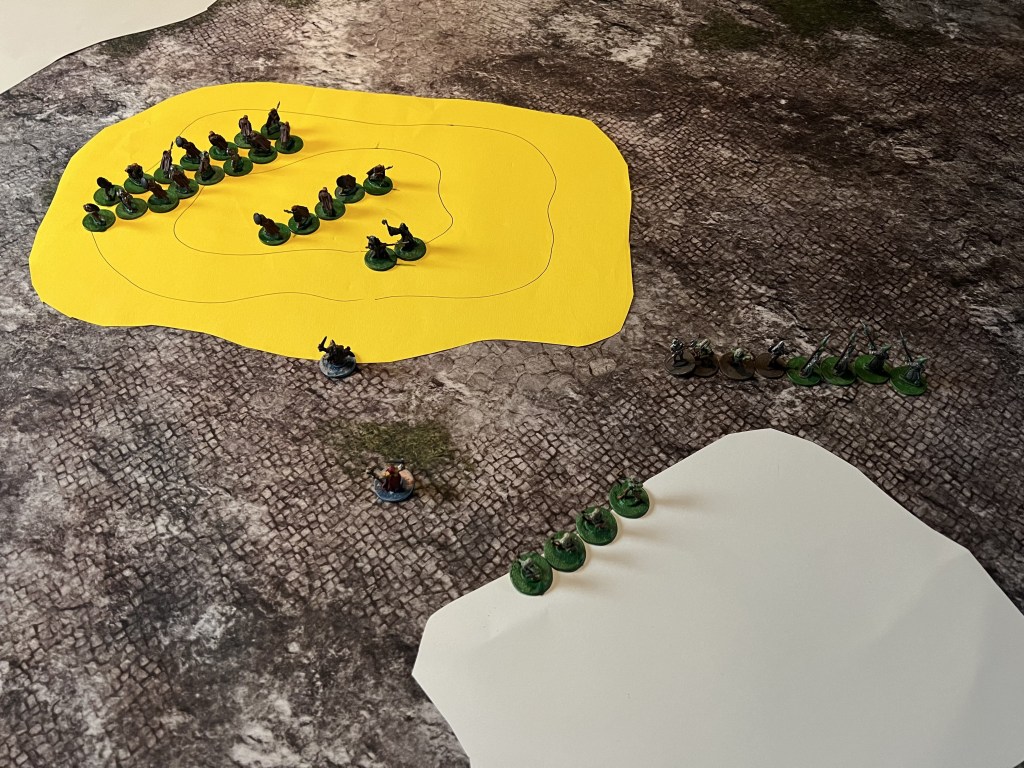
The goblins now have the hill, if they can keep it by the end of turn six then they will enter the dungeon complex and win the scenario. The Magic user closest to the woods on the left uses Light on the goblin leader, he fails his spell save, and effectively reduces one of the strong goblins effectiveness down a grade to light foot in all the confusion. But now he’s visible to the goblin player. The elves shoot into the strong goblins but cause no deaths. The goblins return fire with their slings and cause no injury. The battle continues.

Turn 5

Goblin Orders: hold the hill and shoot dogs!

Elves orders: The spearmen and Fighters take the hill. The archers shoot. The magic users charge the ones atop the hill.

The magic user charges and becomes visible. The powerful goblins die from a volley of arrows. The spearmen finally reach the hill. The slings of the goblins still do no damage. The fighter/mu kills ten goblins in the melee.

Turn 6

Goblin orders: shoot and hold.

Elves orders: the second F/MU will close to combat. The spearmen will do the same. The archers will fire into the rear mob.

Both the goblins and elves had to shoot over the heads of the melee as in the turn before, and this really reduced their effectiveness, but this turn the goblins got very lucky and wiped out thirty elven archers. During the morale phase the last ten archers fled. The spears and F/MU didn’t have the movement to mount the hill or get into combat. Its very tense.

Victory – Turn 7

The goblins begin to enter the complex and win the game. As I was running the game I totally missed this, and we played another round, caught up in the drama of it all.

Goblin orders: I split my rear unit into two and fight on.

Elves orders: If the spearmen can combat the back rank, do that. The fighters will fight the front rank.

The spearmen are able to meet the back unit of goblins, and the two effectively wiped each other out. The spearmen lost three, and the goblins lost three, then they both failed their morale checks. The elven fighters and fighter/mu’s were totally untouched by the goblins and easily wiped them out.

The remaining sixty goblins managed to escape into the dungeons below the ruins of the chaotic temple.

End

This was an incredibly fun game and only took about an hour and a half to play through. Afterwards the players asked if the levelled elves could descend into the dungeon to hunt the goblins. I think that sounds like a great idea, and will write something up for that.

The modifications I made seemed to help bring the rules into line with the goblins and wood elves of the Monster Manual. The rules that I used from the Huso Chainmail Screen made the fighters really powerful though. They fight as two armoured foot per level, which allowed them to smash through goblins like they were paper dolls, whereas in Ad&d they would only have two attacks a round vs the goblins, not twenty.

In all this seemed to work well and I might well use these rules to play out mass battles in the future. But I would like to run the same scenario using a swords and spells first.

I hope to play another game soon and post more play reports like this. If you enjoyed this, or have any comments or questions please get in touch.

[AD&D] My Time Tracker

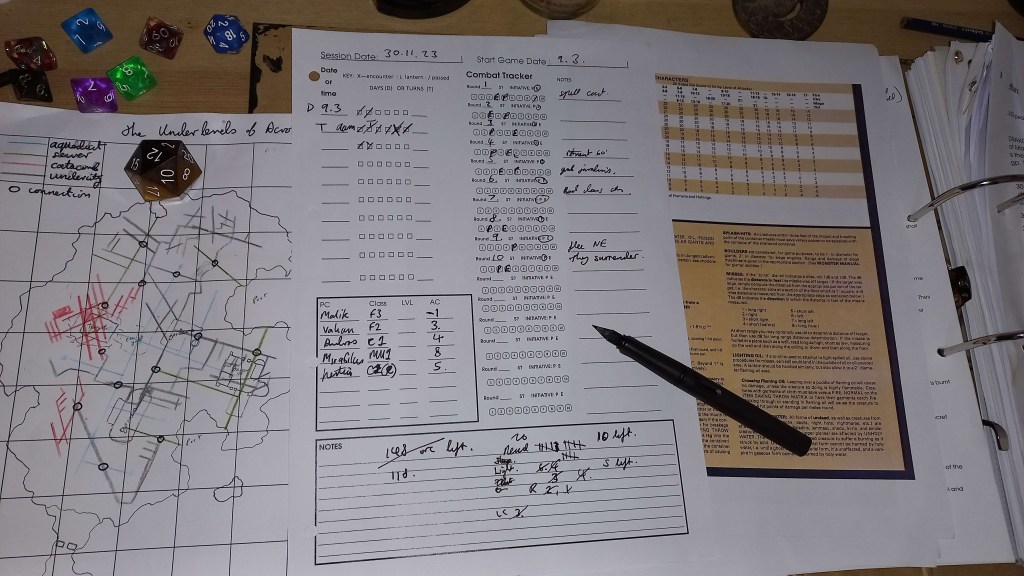
You need a time tracker, I need a time tracker, we all need a time tracker. Well, here I am to give you your medicine. Behold, my new AD&D tracker in use at the table.

Prime Chaos

Time is of the Essence

I’ve been running old school games for a while now, and one thing that differs from other types of roleplaying games is the importance of game time; it’s passing and the necessity of recording of it. We all know that a classic fantasy campaign looses much of its meaning if strict time records are not kept. The reasons are multifarious; daily healing rates, spell acquisition, travel times, and the frequency and odds of random encounters. The list is long and has to be accounted for.

Essentially, time is an important game resource. I don’t want to bang on about this and play at being the broken record, if you’ve played older editions of D&D then you know very well how important this is. I just wanted to post the campaign tracker I’ve made for my current AD&D campaign, since I was unable to find one that fit my needs exactly. 

There are plenty of trackers out there, hell, a scrap of paper would probably do, but none of the trackers I’ve found had exactly what I was looking for. Here are some of the specifics I wanted on my tracker sheet. 

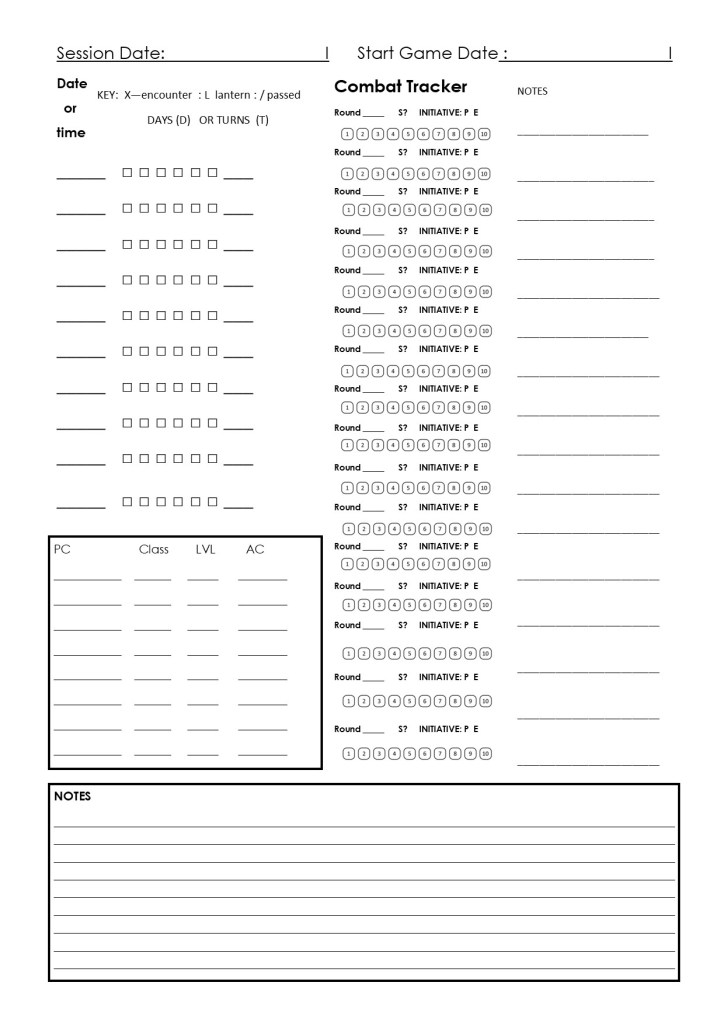
Segments

I wanted to have a segment tracker on my sheet. Though they don’t necessarily come up in every combat, having them on my sheet helps me adjudicate certain situations quickly.

For example, when a spell is cast with multiple segments times, or if there are player characters with readied missile weapons.

An example in a recent game was when a fighter was standing at a door with a net ready to throw (+2 segments as per their DEX bonus), during this round another player character was casting a spell, and before both of them were three charging ghouls.  

The tracker sheets I’ve found online that do have segments usually only supply them up to ten rounds. That makes sense mechanically, since there are ten rounds to a game turn, but what if a combat goes beyond ten minutes? What if you have multiple combats in a game, do you need to use multiple sheets?

I want to use only one tracking sheet per game if I can help it, so I tried cramming as many rounds and segments onto my tracker as possible. When a combat ends, I strike a line below that round and the next combat to occur is recorded below.

I circle which group has the initiative where its labelled P (party) and E (enemy), or both if its simultaneous. 

Turns and Days

You often see check boxes used for recording game turns on tracker sheets. I like that, and I’ve done nothing different here. I just also happen to use the same check box area for the passing of days. I have put a small space next to the rows of turn boxes to record whether the row is recording the passing of days, turns, or hours. There is nothing revolutionary going on here really. 

I have a separate game calendar, so after the game I check how many days have elapsed on this sheet and update it. 

Simplicity

I wanted the sheet to be clutter free, easily printable on A4 paper, black and white, and have enough space for me to record a whole session. We’ll see how that goes over the next few months.

The Tracker

Here is it, I will keep adjusting it as I play more, and if it changes significantly I’ll post an updated version.

AD&D TIME TRACKER

If you have a favourite tracker for AD&D, or one of your own design, please share it with me.